
Site Work: Brownfield + State Superfund
Riverview Innovation & Technology Campus’s (RITC) application to conduct the site remediation and restoration under the New York State Department of Environmental Conservation’s (NYSDEC) Brownfield Cleanup Program was accepted by the agency on February 14, 2020. NYSDEC also announced that day a new Consent Order under the State Superfund program with Honeywell for three separate sections of the property. A Honeywell predecessor company owned the site prior to 1978.
RITC and Honeywell are conducting investigations under similar schedules and using data collected for both programs. The two programs are governed by similar requirements and design criteria. RITC and Honeywell also developed respective Citizen Participation Plans, which outline how the public will be kept informed and allowed to participate in the projects.
Active cleanup and investigations have been ongoing since signing the agreements for both programs.
Riverview Innovation & Technology Campus
NYSDEC Superfund Sites
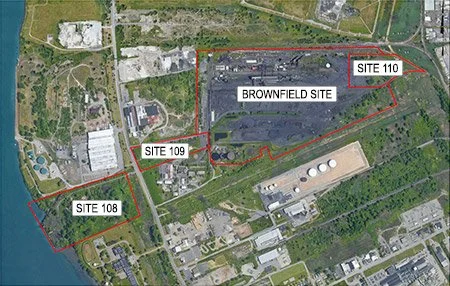
The NYSDEC Superfund Site has been divided into three Operable Units; Sites 108 (OU-3), 109 (OU-2), and 110 (OU-1). Site 108 is located at 3800 River Road and Sites 109 and 110 are located at 3875 River Road.
Initial site investigations have been completed at Site 108. A draft Feasibility Study was submitted to NYSDEC, but additional data are needed to evaluate remedial technologies and identify suitable alternatives for the site. Supplemental investigations are expected to continue into late 2027. Honeywell has worked proactively with EPA since late 2018 to address priority environmental issues associated with Site 108.
Remedial decisions have been issued for Sites 109 and 110 based on prior industrial use assumptions; however, because the Brownfield Site is being remediated to commercial standards, additional evaluation is being conducted at NYSDEC's request to support redevelopment of Sites 109 and 110 under those standards.
Site 108 (OU-3)
Site 108 is located on the southern and central portion of the former Tonawanda Coke facility at 3800 River Road and extends from River Road into the Niagara River. The site historically supported coke manufacturing operations and associated material handling infrastructure, including coal conveyance systems and process-related equipment. Portions of Site 108 were used for disposal and management of process materials generated during plant operations.
Ongoing/Planned Work:
Feasibility Study/Pre-Design Investigations (proposed for 2026 and 2027)
Completed Work:
Remedial investigations including soil, sediment, and groundwater sampling.
Removal of three large above ground coal tar storage tanks as approved and overseen by US EPA, including:
Removal and offsite disposal of water and tar from within the tanks
Demolition, decontamination, and offsite disposal of the tanks
Excavation and offsite disposal of contaminated soil adjacent to the tanks that had resulted from prior releases from the tanks
Backfilling and site restoration
Removal and off-site disposal of the former coal crane and associated riverfront conveyors.
Asbestos removal from the River Road Tunnel and offsite disposal.
Tar pipeline removal.
Air monitoring during storage tank demolition and intrusive activities; results are posted here.
Site 109 (OU-3) & Site 110 (OU-1)
Site 109 is located just east of River Road on the western side of 3875 River Road. In 1977, an unknown quantity of brick, rubble, and related demolition waste was disposed in this area. Since Site 109 was only used for stormwater management, with no other industrial activity, it was included in the State Superfund listing.
Site 110 is located on the northeast portion of the 3875 River Road property and extends east under the National Grid power lines. Materials such as coal tar sludge, fly ash and cinders were reportedly disposed of in this area. The disposal activities occurred prior to 1978. At the time it was included in the State Superfund listing, there was no industrial activity on that section of the Tonawanda Coke Plant.
Ongoing Work:
Feasibility Study for Site 110 - submitted to NYSDEC, under review.
Implementation of Remedial Action Work Plan
Completed Work:
Remedial investigations
Focused Feasibility Study - Site 109.
Remedial Action Work Plan for Site 109
Air monitoring during intrusive activities; results are posted here.
Brownfield Site
Completed/Ongoing Activities:
All above ground production equipment and tanks have been removed.
Risk of emissions and fires from products and abandoned piping has been eliminated.
Shipment of waste has slowed as all known tanks and process equipment have been emptied, cleaned and removed.
Total Tonnage removed:
Solid Waste: 5,953 Tons
Liquid Beneficial Use: 38 Tons
Recycled Materials: 11,749 Tons
Hazardous Waste: 7,630 Tons
Asbestos Containing Materials: 3,698 Tons
Approximately 25,000 tons of potentially hazardous soils have been treated and are no longer hazardous nor pose a risk to the environment.
Approximately 23,000 tons of concrete have been crushed, tested to verify it is clean, and will be reused to construct access roads onsite.
Systematic solidification of potentially hazardous soil, removal of below grade piping, and demolition of process building slabs has allowed workers to identify and remove four previously unknown tanks and sumps that were not documented on building plans.
To date, over 150 million gallons of water have been treated; 36 million gallons of groundwater have been extracted, pretreated and discharged to Town of Tonawanda, producing revenue to the Town of over $260,000.
Collection systems capture and treat all water that falls (rain and snow) on the site.
Monthly monitoring of groundwater levels allows for verification to control site groundwater in former production area.
All above ground production equipment and tanks have been removed. The risk of emissions and fires from the products and abandoned wastes has been eliminated.
No pipes cross site boundary except current water, sewer, and electric utilities.
All underground process piping has been severed permanently.
Approximately 8,900 LF of underground coke oven gas pipe has been removed.
Approximately 10,200 LF of underground process pipes remain to be removed this year.
Air monitoring during intrusive activities; results are posted here.
Documents prepared:
48 Work Plans and reports from 50 - 129,000 pages; all are in local library, on website, and on NYSDEC InfoLocator. (https://extapps.dec.ny.gov/data/DecDocs/C915353/)
Stack demolition plan prepared and implemented on time and safely.
Remedial Investigation Report provides comprehensive investigation of property; more than 129,000 pages including data.
In addition to remedial investigation, an additional 1,000 samples have been collected throughout implementation of the IRM and to confirm site conditions are improving.
Alternatives Analysis Report (the “AAR”) is a comprehensive analysis of what is required to complete the BCP project and get site ready for redevelopment. The AAR has been submitted and should be available for public comment in 2024.
The Remedial Action Work Plan has been approved by the NYSDEC and NYSDOH.
Brownfield Cleanup Program Documents
Remedial Action Work Plan - BCP Site #C915353 - June 2026
US EPA Removal Action
US EPA worked with NYSDEC to shut down operations at Tonawanda Coke. According to US EPA’s December 2019 Fact Sheet, its removal program included:
“Securing all drums, containers and tanks; treating process waste before being discharged to the local water treatment plant and providing other emergency stabilization actions. In Fall 2018, sixty coke ovens were closed, following the emptying and purging of gases from these structures. This marked the end of coke production at the facility. Throughout 2019, EPA removed certain contaminated soil at the facility to mitigate impacts to surface water and stop the spread of contamination. Floors contaminated with chemicals in several buildings have been cleaned, and over a million gallons of contaminated water have been treated. Other areas contaminated with hazardous substances were addressed by EPA to prevent the release of the contaminants to the environment.”
US EPA’s website: https://www.epa.gov/ny/tonawanda-coke-corporation-tcc-site